North Carolina Planting Dates: Frost Probabilities by Region
North Carolina gardeners can share a state and still face very different frost risks. A planting date that works near the coast may be premature inland or at higher elevations. This guide explains how frost probabilities vary by region, how to use them alongside soil warmth and crop tolerance, and how to build a flexible planting calendar.
What frost probabilities tell you
A frost date is not a promise that frost will happen on a particular day. It is a summary of historical weather observations: a way to describe how often temperatures at a weather station reached a chosen frost threshold during a particular part of the year. The probability attached to a date indicates how likely that threshold was to have occurred by then in the records used to calculate it.
The probability matters because there is no single date that is equally useful for every gardener. A date with a lower probability of frost may represent a more cautious planning point, while a date with a higher probability may reflect a greater willingness to risk a late cold event. The useful choice depends on what you intend to plant and how much damage you are prepared to accept.
These statistics describe past conditions, not a forecast for your yard. A late frost can occur after a date that looks favorable in historical data. A mild stretch can also arrive early. Treat a probability as a way to compare risk, not as a signal that frost is impossible once the calendar reaches a certain point.
The numbers also depend on the weather station and the period of records used. A station may represent an airport, a town, or another observation site, not the exact conditions of your property. A station’s results are most useful as a regional reference. Hills, valleys, distance from the coast, nearby water, buildings, and other site features can make your garden warmer or colder than the station.
When you consult a frost-date resource, check what it actually reports:
- The weather station or location. A nearby station may be a reasonable starting point, but it does not measure your yard.
- The kind of event being tracked. A light frost, a ground-level frost, and a colder freeze can affect plants differently.
- The stated probability. Don’t compare dates without checking whether they represent the same probability.
- The period or records behind the estimate. Historical estimates may differ when they use different observation periods.
- The season being described. Spring’s last frost and fall’s first frost are separate planning questions.
The distinction between a frost and a freeze is important. Some plants can take a light frost with little harm, while tender growth may be injured by a brief cold night. Colder or longer-lasting conditions can cause more serious damage. A weather report that says the air temperature will stay above freezing does not always rule out frost near the ground. Can Ground Frost Damage Garden Plants When Air Stays Above Freezing? explains why the temperature measured at standard observation height may not tell the whole story for low-growing plants.
A frost probability is also not the same thing as a hardiness zone. A hardiness zone describes the pattern of extreme winter minimum temperatures used to assess perennial plant survival. It does not tell you when the last spring frost will occur or whether soil is warm enough to sow summer vegetables. For a closer look at how the state’s regions differ, see North Carolina Planting Regions: Coastal, Piedmont, or Mountain?.
Why planting risk varies across North Carolina
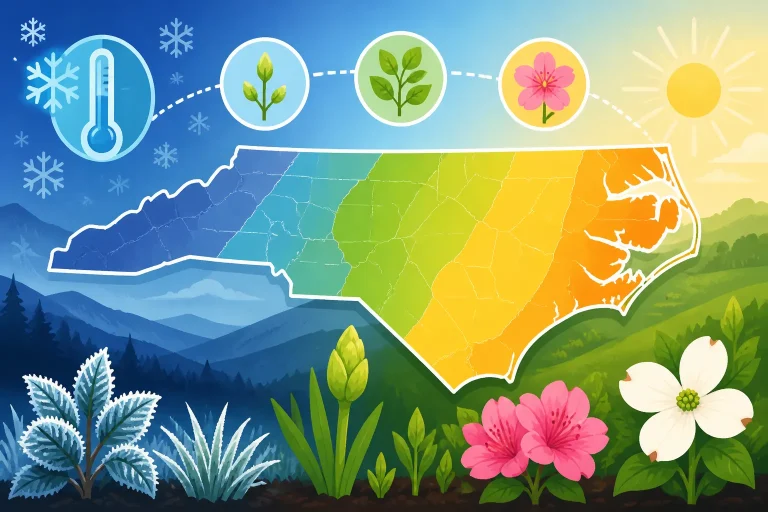
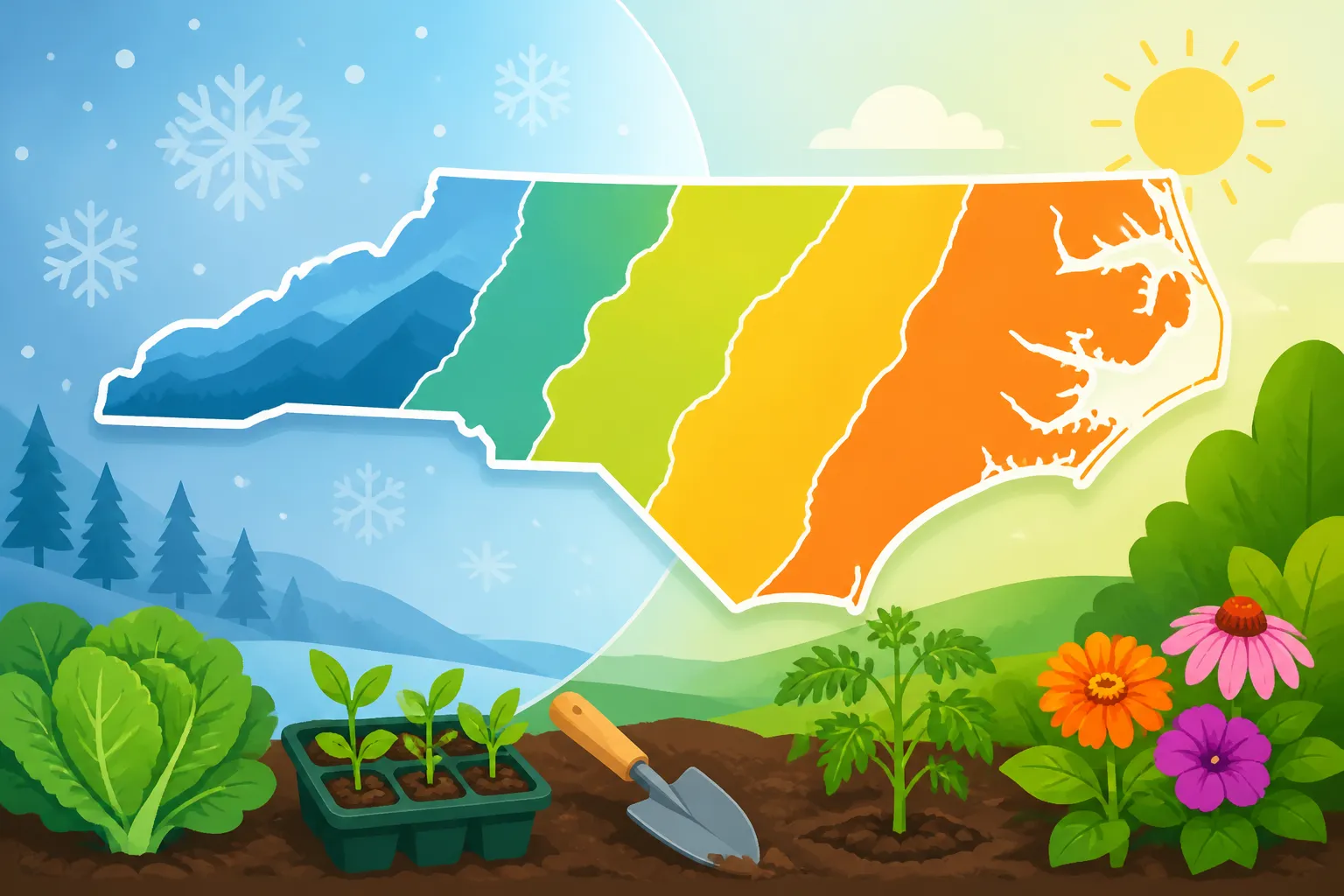
North Carolina’s geography makes a statewide planting date a poor fit for many gardens. Elevation, coastal influence, terrain, and local exposure all affect how quickly a site warms in spring and how readily it loses heat overnight. Regional planting calendars are useful starting points, but the conditions of a specific yard can shift the practical window.
Coastal Plain
The Coastal Plain generally experiences a different spring pattern from inland and mountain areas. The Atlantic Ocean and other nearby water can moderate temperature changes, and lower-elevation coastal locations may warm earlier than colder inland sites. That can create opportunities to begin some planting sooner—but not a guarantee of frost-free weather.
Coastal conditions vary within the region. A garden close to open water may experience different temperature swings from a site farther inland. Low, exposed ground may collect cold air even in a generally mild area. Wind exposure, sandy soil, and drainage also affect how quickly beds warm and dry.
For coastal gardeners, an early-looking forecast should still be checked against the crop’s needs. A plant may tolerate a brief chill but fail to establish well in cold soil. And a tender transplant that is protected from wind can still be damaged by a late cold night. Coastal North Carolina Spring Planting: Moving Ahead of Inland Dates looks more closely at how coastal conditions can affect spring decisions.
Piedmont
The Piedmont sits between the coast and the mountains, but it is not a uniform band of weather. Elevation, rolling terrain, distance from the coast, and local cold-air drainage can all influence frost risk. Two nearby gardens may not experience the same conditions, especially if one is in a low spot and the other is on a slope.
A Piedmont gardener should use regional information as a baseline, then pay attention to the garden’s own pattern. Does frost linger in a low corner? Does a south-facing wall warm the bed early? Are open areas exposed to cold winds? Such observations help explain why a neighboring yard may seem ready to plant before yours.
The risk of a late cold event is especially relevant for tender crops and newly transplanted seedlings. A mild spell can encourage quick planting, but it does not erase the possibility of a return to chilly nights. Why Spring Frost Dates Vary Widely Across North Carolina discusses the reasons a single state date does not describe every location.
Mountains and higher elevations
Mountain gardens can face a shorter and more variable warm-season window than lower-elevation sites. Elevation and terrain affect both the timing of spring warming and the way cold air moves. Sheltered slopes, exposed ridges, narrow valleys, and high-elevation gardens can have distinct conditions even within the same broader area.
In spring, a sunny afternoon can make a bed feel ready while overnight temperatures remain a concern. The calendar may also be less reliable where local topography creates cold pockets. Gardeners in the mountains should be particularly cautious about using a nearby town’s conditions as a direct substitute for their own site.
This doesn’t mean every mountain garden must wait until the same point. Cold-tolerant crops may be planted under conditions that would be risky for tender crops, and a protected bed may warm faster than an exposed one. The key is to separate the question “Can this crop tolerate a chilly night?” from “Is the soil and weather suitable for it to grow?” For more detail, see Western NC Mountain Spring Planting: Navigating Late-April Freezes and How Elevation Changes Last Spring Freeze Timing in Western NC.
The garden’s own microclimate
Regional frost information cannot account for every small-scale difference in a yard. Cold air tends to settle in low areas and can flow downhill into hollows. A sheltered spot near a building may stay warmer than an open bed, while a windy or exposed location may lose heat more quickly. Tree cover can reduce sky exposure but may also limit the sun that warms the soil.
Keep a simple record through the seasons. Note where frost remains longest, which beds thaw first, where puddles persist, and whether a wall or fence changes wind exposure. These observations won’t replace weather data, but they help you interpret it.
If a bed has no history yet, start conservatively with tender crops. Plant a small amount first, watch how it responds, and expand later when conditions are clearer. That approach reduces the cost of guessing wrong and helps you learn the site’s patterns.
How to use frost data to build a spring calendar
A regional frost estimate is most useful when it is one part of a decision, rather than a date circled on the calendar. Combine the probability, your local site, the crop’s cold tolerance, soil conditions, and the forecast. North Carolina Spring and Fall Planting Schedule Overview provides a broader seasonal framework, while Frost Dates vs Soil Warmth: When to Plant in North Carolina explains why frost risk and soil temperature answer different questions.
A practical planning process looks like this:
- Identify the closest useful weather reference. Look for a frost or freeze estimate tied to a named station or a clearly described region. Check the probability and the period of records behind it. If you compare two sources, make sure they refer to comparable probabilities and events.
- Decide how much risk the crop can take. Cold-tolerant crops and tender crops do not belong in the same planting decision. A possible light frost may be manageable for one crop and damaging for another.
- Check the soil, not only the air. Cold, wet, or compacted soil can slow germination and root growth, even if the daytime forecast looks mild. Warm-season crops generally need warmer soil than cool-season crops. A seed packet or reliable crop-specific recommendation can help set expectations.
- Look at the short-range forecast. Historical odds describe patterns over time; the forecast helps you evaluate the immediate stretch of weather. Pay attention to overnight lows and any frost advisory or freeze warning that applies to your area.
- Choose a planting strategy. You can wait, plant only cold-tolerant crops, start with a small trial, use suitable protection, or set out a succession of plantings. The best choice depends on the crop, your space, and how much time you can spend managing young plants.
- Keep a record. Note planting dates, soil conditions, cold nights, and plant response. Over time, your notes help turn a broad regional calendar into a more useful plan for your property.
For each crop, consider more than one stage of growth. Seeds in the soil, newly emerged seedlings, indoor-grown transplants, and established plants may not respond to cold in the same way. A transplant can be especially vulnerable while it adjusts to outdoor conditions. Even a crop known to tolerate cool weather may be set back by harsh conditions or a sudden change.
A sample decision, without a fixed calendar date
Suppose you are deciding whether to set out a tender summer vegetable. The regional frost estimate looks encouraging, but the next forecast includes chilly nights and the bed still feels cold. The sensible response is not necessarily to abandon the season. You could delay the transplant, check the soil, protect the seedling if conditions warrant, or plant a small number and keep a backup.
For a cool-season crop, the same forecast may lead to a different decision. A brief chill may be less concerning, though very cold conditions or prolonged exposure can still cause harm. If the seed packet or a trusted local recommendation gives a temperature or soil requirement, use that information rather than guessing from a general frost date.
That difference is why a single “safe to plant” date can be misleading. It hides the crop, the growth stage, the site, and the type of cold event that matters.
Why a succession approach helps
Planting everything on one day puts the whole crop at the mercy of one stretch of weather. A succession approach spreads some of the risk. Instead of setting out every transplant or sowing every seed at once, divide the planting into stages. If early plants struggle, later ones may still have a better start. If the early planting succeeds, the later sowing can extend the harvest.
Succession planting also works well when the season changes quickly. Cool-season crops may perform best before heat builds, while warm-season crops need conditions that support steady growth. Succession Planting Timelines for Year-Round North Carolina Harvests offers a separate look at organizing repeated plantings.
Match the planting decision to the crop
The most useful way to translate frost information into action is to sort crops by their needs. Broad categories help with planning, but they are not a substitute for a crop-specific recommendation. Even within a category, varieties and growth stages can differ.
| Crop or plant group | How to think about spring frost risk | Other factor to check |
|---|---|---|
| Cool-season vegetables and greens | Many tolerate cool conditions better than tender summer crops, though tolerance varies by crop and stage | Whether soil is workable and suitable for germination |
| Cold-hardy roots and peas | Often suitable for earlier planting than tender crops, depending on local conditions | Soil moisture, drainage, and seedbed quality |
| Warm-season vegetables | More vulnerable to cold stress; a frost estimate alone is not enough to establish readiness | Soil warmth and stable growing conditions |
| Tender herbs and annual flowers | Young plants can be damaged by cold even after a mild stretch | Acclimation, exposure, and protection options |
| Established perennial plants | Winter hardiness does not necessarily protect new growth from a spring cold snap | Bud or shoot stage and local exposure |
| Fruit trees and flowering ornamentals | The concern may be damage to swelling buds or open flowers, not the survival of the whole plant | Development stage and forecast conditions |
Cool-season crops
Cool-season vegetables are often the first crops gardeners consider when spring begins to feel possible. Many can grow in cooler conditions than summer vegetables, so a frost probability that would make a tender crop risky may not automatically rule out every cool-season planting.
Still, “cool-season” does not mean indestructible. A hard freeze, prolonged cold, waterlogged soil, or a sudden temperature drop can harm plants. Newly emerged seedlings may be more exposed than established plants, and a crop can survive cold yet grow slowly until conditions improve.
Before sowing, check that the bed is workable rather than wet and clumpy. Seeds need suitable contact with the soil and conditions that support germination. If you are choosing between sowing outside and starting under cover, Direct Sowing vs Indoor Seed Starting for Early Carolina Springs can help you weigh the options.
Warm-season vegetables
Tomatoes, peppers, beans, squash, and other warm-season crops need more than a low chance of frost. Cold soil can delay root activity and leave seedlings stalled, even when the day is sunny. A spell of mild weather may be followed by cold nights, and a young transplant has little time to adapt if conditions change abruptly.
Wait for signs of sustained readiness rather than treating one warm afternoon as proof that the season has turned. Check the crop’s recommended soil and temperature conditions, the recent weather pattern, and the short-range forecast. If a cool spell is expected, delaying planting can be less troublesome than trying to nurse a stressed transplant.
The trade-off is that waiting too long may shorten the time available for a crop to mature, especially in cooler or higher-elevation locations. That’s where seed maturity information and the expected length of the local growing season matter. How to Match Vegetable Maturity Days to Local Growing Seasons explains how to include maturity time in crop planning.
Seedlings and transplants
A plant grown indoors or purchased from a nursery has not necessarily adjusted to outdoor conditions. Sun, wind, and fluctuating temperatures can stress leaves and stems. Gradual acclimation helps a transplant transition, but it does not make a frost-sensitive crop frost-proof.
If you are moving seedlings outdoors, consider the forecast as well as the regional estimate. Be ready to move containers or use appropriate protection if a cold event is expected. Protection can reduce exposure, but it is not a substitute for checking the material’s limits and using it as intended. For details on the transition, see When Is It Safe to Move Seedlings Outdoors in North Carolina?.
A transplant can also be set back by overly wet soil or poor drainage. If the weather is cool and the bed stays saturated after rain, waiting for better conditions can improve establishment even when frost risk seems low.
Flowers, shrubs, and trees
The same frost framework applies to ornamentals, but the stakes and timing may differ. A perennial may survive winter yet lose early leaves or flower buds to a late cold snap. A flowering tree’s vulnerability can change as buds swell and open. A shrub that is well adapted to the region is not automatically protected from every unusual spring chill.
Avoid treating hardiness as a guarantee against spring damage. Hardiness zones describe winter minimum patterns, while spring frost risk depends on when temperatures fall and what stage the plant has reached. If a favorite plant has begun active growth, follow plant-specific guidance and watch local forecasts. Protecting Tender Crops During Late North Carolina Spring Freezes covers protection considerations for vulnerable plants during cold snaps.
Plan fall planting around the first frost
Spring planting gets much of the attention, but frost probabilities also help with fall vegetables and flowers. The main question changes: instead of asking how long to delay planting, ask how much time remains for a crop to establish, mature, or produce before colder weather arrives.
Fall planting depends on the crop’s days to maturity, the expected local freeze pattern, and how quickly conditions cool at your site. A crop planted too late may not have enough time to develop. A crop planted too early may face summer heat before it is ready for cooler-season growth. These are separate constraints, and one frost estimate cannot resolve both.
Use this sequence when planning:
- Choose the crop and its purpose. Are you growing for a quick harvest, a longer fall harvest, or overwintering? Each goal calls for a different timeline.
- Check maturity information. Use crop-specific guidance to estimate how much growing time the plant needs. Account for the fact that actual growth can slow in challenging weather.
- Compare that window with local fall risk. Find a relevant first-frost or freeze estimate and check the probability, station, and record period. Remember that it describes historical odds, not a guarantee.
- Work backward from the desired harvest or establishment stage. Allow for germination and early growth, not only the time listed to maturity.
- Adjust for heat and bed conditions. Summer warmth can make fall seedlings difficult to establish. Shade, moisture management, and timing may matter as much as the eventual frost.
- Keep a backup plan. A later sowing may still be worthwhile for fast crops, but a long-maturing crop may be a poor bet if the remaining growing window is short.
Regional differences apply in fall too. Coastal areas may offer a longer window for some crops than higher or colder inland locations, but site conditions still matter. A sheltered coastal bed is not identical to a windy one, and a mountain garden may cool sooner than a lower site in the same general region. The right choice is not to assume that a broad regional advantage guarantees a certain harvest, but to use it as a starting point and then assess local conditions.
For a detailed regional approach, see North Carolina Fall Planting Guide: Mountains to the Coast and Guide to Sowing Fall Vegetables and Cover Crops in NC. If you are already behind your original plan, Is It Too Late to Plant Fall Vegetables in North Carolina? can help you assess what may still be practical.
Protecting fall seedlings from summer conditions
Fall crops are often started while temperatures remain hot. A low frost risk in the coming weeks does not mean seedlings are ready for full sun and dry soil. Young plants may struggle in heat, especially if their roots are shallow or the bed dries quickly. Choose a location and sowing approach that help them establish before the weather turns.
Check soil moisture beneath the surface rather than relying on the appearance of dry mulch or topsoil. Small seedlings can be stressed when the root zone dries, but constantly saturated soil can also cause problems. A steady, appropriate moisture level supports establishment; adjust watering to the bed and weather rather than following a rigid schedule.
Adjust the calendar to your yard and the current forecast
A good planting calendar has two layers: a broad regional plan and a short-term decision for the garden in front of you. The regional plan helps organize the season. The forecast, soil, crop, and microclimate help determine what to do this week.
Track conditions, not just dates
Record the date of notable cold nights and where frost appears first. You can also note soil warmth, how quickly a bed dries after rain, and when nearby plants begin active growth. A few seasons of notes can reveal patterns that a general region map cannot show.
Avoid reading too much into one year. An unusually early warm spell or late cold event does not necessarily predict the next season. Use your records to understand the relative behavior of your yard—for example, which bed tends to warm sooner—not to treat a past date as a permanent rule.
A basic planting log can include:
- Crop and variety
- Sowing or transplanting date
- Whether the crop was direct-sown or started indoors
- Bed location and exposure
- Soil condition at planting
- Cold events or heat spells after planting
- Germination, transplant stress, and harvest outcome
These notes are especially useful if you garden in several microclimates. A raised bed against a sunny wall, an open plot, and a low corner may each need a different approach.
Use protection as a backup, not a substitute for timing
Row covers and other protective methods can reduce exposure during a brief cold event, but their effectiveness depends on the material, setup, crop, and weather. They may not provide enough protection during a severe or prolonged freeze. Secure covers so they do not damage plants, and follow product instructions where applicable.
Protection also requires attention. Covers may need to be removed or adjusted as conditions change, and plants still need suitable light, water, and airflow. If a forecast points to a cold event beyond what your materials can handle, postponing planting or moving containers may be the safer option.
Do not assume that a protected crop is safe simply because the air temperature sounds close to freezing. Local wind, duration, moisture, ground conditions, and the plant’s position all influence the outcome. Check the forecast and local notices, and make a decision based on the crop’s actual sensitivity.
Avoid the holiday-date shortcut
A holiday or a familiar calendar date may be easy to remember, but it does not account for a year’s weather, a garden’s elevation, or the needs of a particular crop. The same date can bring different conditions from one year to another. It can also be too early for tender crops in one location and needlessly cautious for a cold-tolerant crop elsewhere.
Use dates as planning reminders, not as automatic permission to plant. Why Holiday Planting Rules Fail for North Carolina Gardeners explains why seasonal decisions are better tied to conditions than to a fixed day on the calendar.
A concise decision checklist
Before planting, ask:
- Is the crop tolerant of the cold conditions that may still occur?
- Is it seed, a young seedling, a newly acclimated transplant, or an established plant?
- Does the soil meet the crop’s needs for warmth, moisture, and drainage?
- Does the frost estimate match the region, station, probability, and season you need?
- What does the short-range forecast say about overnight lows?
- Does this spot in the yard tend to collect cold air or warm early?
- Can you protect the planting reliably, or would waiting be simpler?
- If the first planting fails, do you have time and seed or plants for another try?
There is no single answer that fits every bed. For a cold-tolerant crop in workable soil, planting before the last likely frost may be reasonable. For a tender transplant in cold ground, waiting may improve the odds. For fall crops, the challenge is to give plants enough time to establish without exposing them to summer stress. In each case, the probability is a planning tool; the crop and the site complete the decision.
Frequently Asked Questions
Does a frost probability tell me the exact day I can plant?
No. It describes historical risk at a particular station and for a stated probability. It does not guarantee that frost will end on a specific day or that your yard matches the station. Combine it with crop tolerance, soil conditions, your microclimate, and the forecast.
Why can a nearby garden have different frost conditions?
Elevation, slope, cold-air drainage, wind exposure, buildings, vegetation, and nearby water can all influence a garden’s temperature. A weather station is a regional reference, not a measurement of every yard.
Can I plant cool-season crops before the last spring frost?
Some cool-season crops tolerate chilly conditions better than tender summer vegetables, but tolerance varies by crop and growth stage. Check crop-specific guidance and consider soil condition and the forecast rather than relying on a date alone.
Are hardiness zones useful for choosing spring planting dates?
They can help assess winter survival for perennial plants, but they do not tell you when spring frost will end or when soil is warm enough for vegetables. Frost estimates, crop guidance, and local conditions address those questions more directly.
Should I use the same approach for fall planting?
The same principles apply, but the planning question changes. Compare the crop’s time to maturity and establishment needs with local fall freeze risk, and account for summer heat that may affect seedlings before cooler weather arrives.
Disclaimer
This article is for general informational purposes only and does not constitute professional advice. Laws, prices and regulations vary by location and change over time. Consult a qualified professional for guidance on your specific situation. North Carolina Gardening Guide is not a government agency and is not affiliated with any university extension, state department of agriculture or other government agency.